
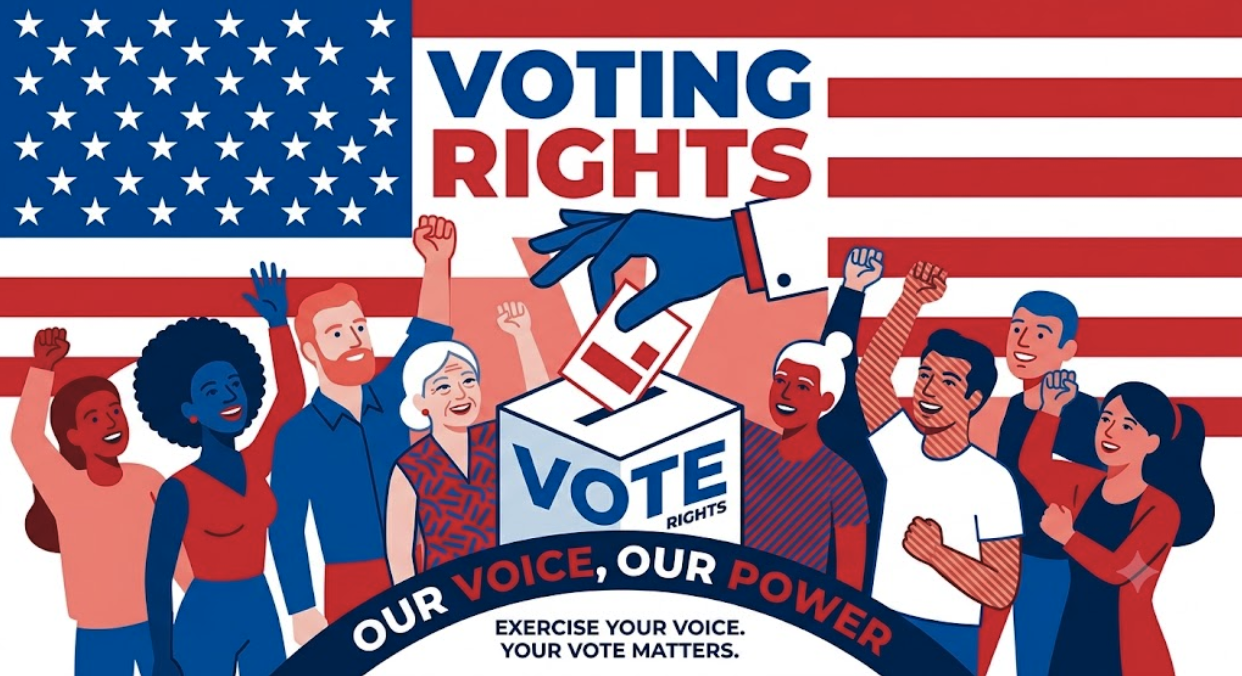
Voting Rights Enable All Others:
A Brief History
One could contend that the right to vote is the most important among all our rights; it's that right that provides for and enables all others. Lose it and every other protection becomes fleeting.
The vast majority of our history involves the expansion of voting rights and, as a result, broader involvement in our democracy. In fact, during the first 237 years of this nation, voting rights have been expanded, given first to a small minority but then extended to nearly all citizens. However, this growth was not freely given by benevolent patriarchal politicians; these rights were hard-fought through decades of peaceful, persistent pressure and, in some instances, bloodshed.
Democratic voting rights are expressed in principle in the initial words of the Declaration of Independence, beginning with the famous words that all people "are created equal … endowed … with certain unalienable Rights." The Declaration goes on to proclaim that "Governments are instituted among" the people deriving their "powers from the consent of the governed." Voting rights were enshrined directly in the 14th and 15th Amendments to the US Constitution in the 1860 and 1870s. But it wasn’t until the Voting Rights Act – nearly 100 years later in 1965 – that those Amendments were enforced, addressing the state-level Jim Crow laws that effectively disenfranchised minority voters. The Voting Rights Act only came about as a result of civic engagement and the Civil Rights Movement.
Sadly, since 2013 we have seen major degradation of important provisions of the Voting Rights Act, followed immediately by state-level restrictions. Since the 2020 election, states have passed 125 restrictive voting measures, which represents a 4-fold increase over historical levels. These tactics reduce voter participation using strict photo-ID laws, shortened early voting windows, widespread polling place closures, and restrictions on mail-in ballots, drop boxes, and voter registration rolls. The white-to-minority turnout gap is widening in formerly Voting Rights Act-protected jurisdictions. These tactics have resulted in a clear separation – an alienation – between the people and their government.
“Why would a government restrict voting rights?” The answer is disturbing and simple: structural, long-game methods of voter disengagement and discouragement allows those in power to maintain power.
The restriction of voting rights presents an existential threat to our democracy.
We have the power to restore and rebuild our democracy, to restore a government that represents our needs and defends our rights. We are blessed to live in this great nation which gifted us the potential of self-governance. We owe it to the many people who fought and dedicated their lives to these freedoms. We owe it to our children and their descendants who will inherit these burdens and freedoms. We owe it to them to fight.
This moment is historic in its importance; we must rise and steadfastly exercise our access and right to vote.